Stand on One Foot, Learn Something: The Balance Audit Nobody Runs
The first time most people think about balance is in a parking lot, mid-stumble, hand out, heart going. Which is a strange way to manage a skill you use every day. Balance isn't a fall-prevention topic for other people. It's a trainable capacity, and it's one of the few things you can honestly assess on a Tuesday morning in your kitchen with no equipment at all.
Balance is three systems arguing politely
Standing still looks passive. It isn't. Your body is constantly integrating three streams of information: what your eyes report about the room, what your inner ear reports about your head's position, and what the sensors in your feet, ankles, and hips report about the ground. The cerebellum does the refereeing and the ankle muscles execute the corrections.
That's why balance is such a good general probe. It requires accurate sensing, fast processing, and sufficient strength to act on the decision. When any one of those slips — an old ankle sprain, reduced vision, a neuropathy from diabetes, a vestibular issue — the system compensates until it can't, and that's often when someone falls.
What the research actually shows
In a 2022 study published in the British Journal of Sports Medicine, adults who couldn't hold a ten-second one-leg stance had substantially higher mortality risk over the following decade than those who could. A 2024 paper in Mayo Clinic Proceedings found that performance on a 30-second single-leg balance test tracked with neuromuscular aging, independent of other measures. And brain imaging work has linked longer single-leg balance time with better integrity of white matter and small-vessel health in the brain, which makes conceptual sense: the same systems that keep you upright keep your cerebral circulation honest.
Now the honest part. Most of these studies were done in middle-aged and older adults, and they show association, not causation. Failing the test doesn't mean you're doomed; it means the system that keeps you off the floor is underperforming and will respond to practice. That's a good problem to have, because balance improves quickly.
The assessment, done safely
Do this near a kitchen counter or a wall you can grab. Shoes off, hard floor, no rug that slides, no phone in your hand.
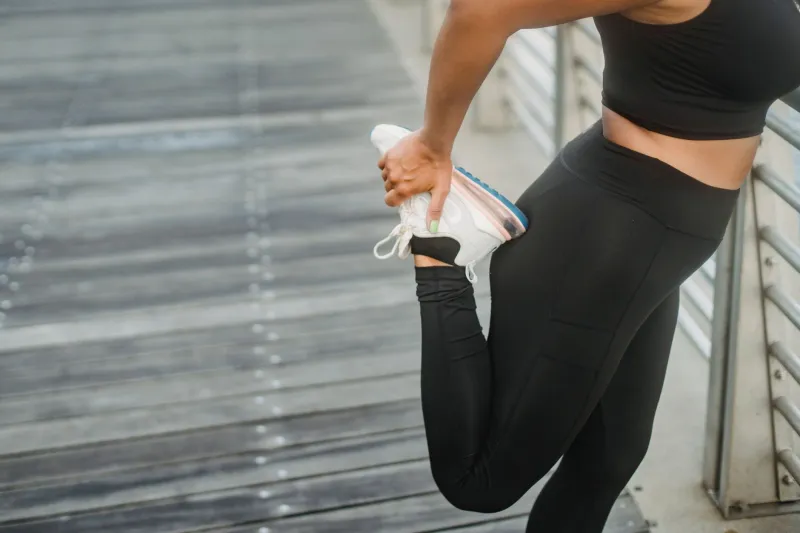
Stand on one foot with the other foot lifted off the floor. Cross your arms over your chest. Start a timer. Stop when your lifted foot touches the ground, your arms come uncrossed, your stance foot hops or shifts, or you hit 60 seconds. Do three attempts per side, then take the best.
Eyes open first. Only after that's comfortable, try eyes closed with a wall within arm's reach — that's the harder version, and you don't need to win it.
Reading your result. A typical healthy adult under 60 should clear 30 seconds per side with eyes open without much drama. Under 10 seconds is a flag. A gap of more than 10 to 15 seconds between your left and your right is also worth noting, since it often points to an old injury that never got rehabbed. Close your eyes and 10 to 15 seconds is respectable, not embarrassing.
A four-week plan that doesn't require a mat
Week 1. Baseline, then practice. Three times a week, stand on one foot next to the counter for 20 seconds per side, eyes open. Brush your teeth on one leg. That's it. Volume, not difficulty.
Week 2. Same holds, but turn your head slowly left and right while you stand. This trains the vestibular piece, and it's harder than it sounds. Alternate which leg goes first so you don't always lead with your strong side.
Week 3. Two new drills. Single-leg reach: stand on one leg and tap your other foot forward, to the side, and behind you as if the floor were a clock face, keeping your hips level. Heel-to-toe walking down a hallway, ten steps forward and ten back, four times a week.
Week 4. Add an uneven surface — a folded towel or a couch cushion — for 20-second holds with a hand hovering near the counter. Add ten slow bodyweight calf raises per leg, because ankles do most of the correcting. Retest at the end of the week.
What to do if you fail it
If you can't hold ten seconds per side with eyes open, or if your balance has clearly gotten worse over the past year, don't just grind the drills harder. Talk to a physical therapist or your doctor. Balance loss can come from medications, blood pressure drops when standing, vitamin B12 deficiency, hearing loss, vision changes, or foot problems — all of which are addressable and none of which a balance drill fixes. An annual eye exam and a hearing check are part of this conversation, not a separate one.
The point of testing isn't to score yourself. It's to find the weak link while it's still a weak link and not a story about the parking lot. Ten seconds on one foot, once a week, is a cheap audit of a system you'll need for the next fifty years.